
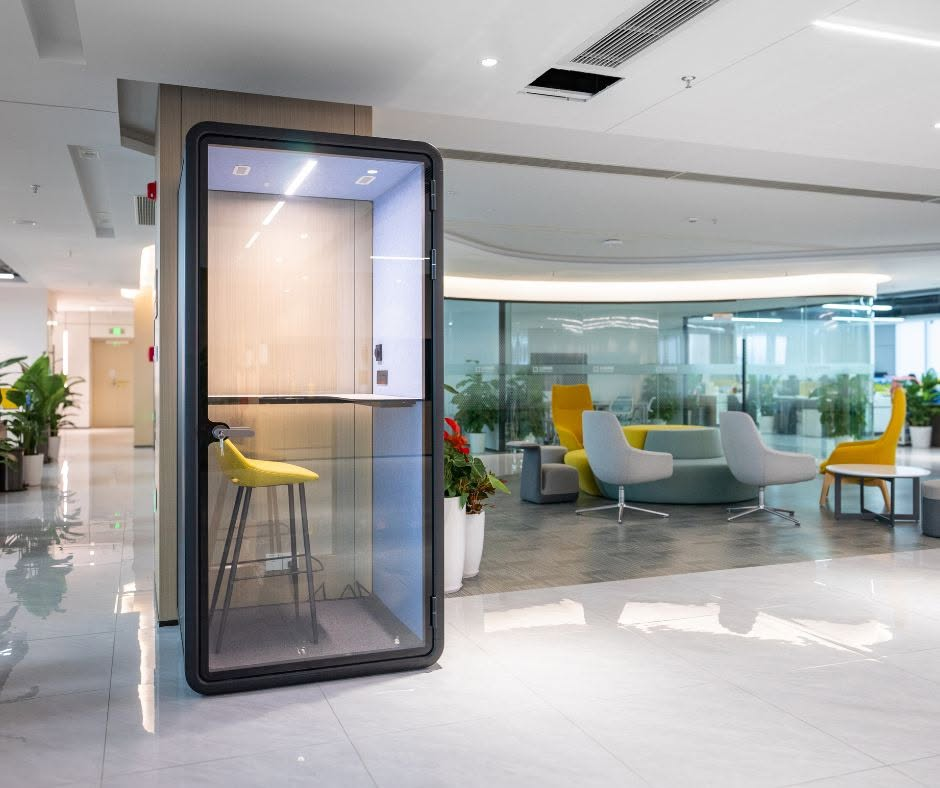
From the workshop floor. Not from a marketing team.
This question shows up in our inbox about once a week, in a dozen different wordings. It usually goes something like: “I only need space for one person. Is a single booth actually worth the money, or am I buying an expensive phone box?”
Reasonable thing to ask. I’d ask it too.
Here’s the honest answer: about half the single booths on the market are exactly what that customer is afraid of. Thin wall panels, a hollow-core door, a fan that whines like a hairdryer on low. Slap a glass door on a cabinet and you can call it a pod.
The one we build isn’t that. And I’ll show you the difference through four jobs people actually use it for — because that’s how our customers explain it to us, not how a spec sheet does.
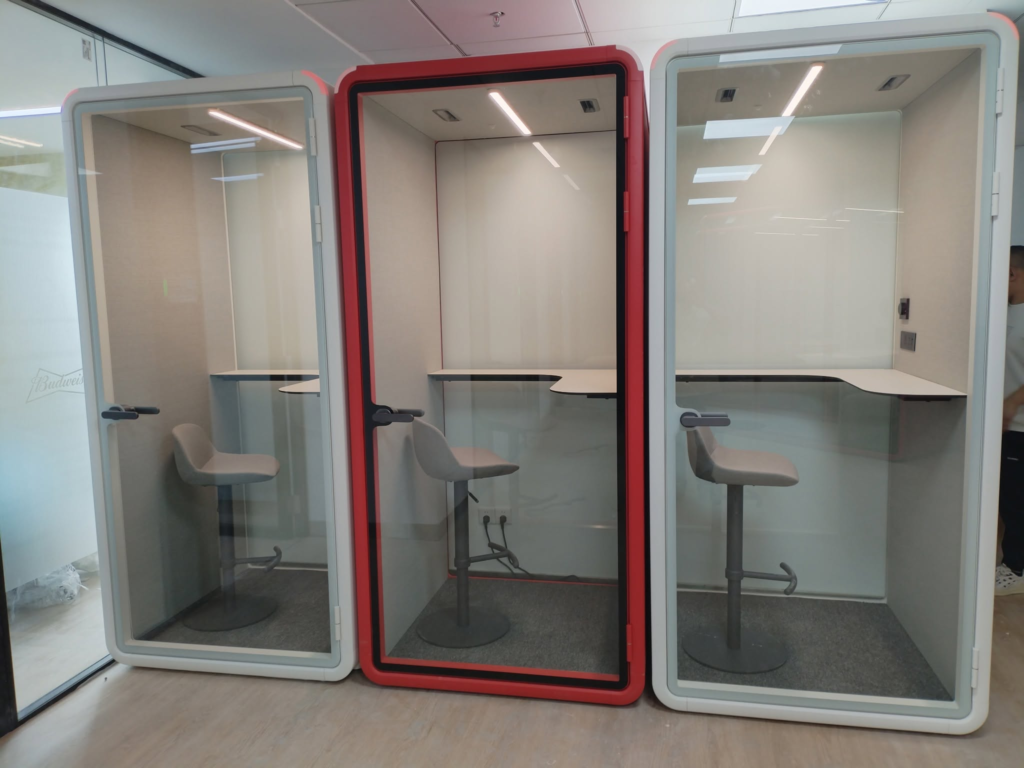
Quiet reading pod — for libraries and study rooms that stopped being quiet
I don’t know when study tables became social spaces, but they did. Group projects spread across four seats, phones on speaker, someone unwrapping a granola bar with the intensity of a surgeon. In offices it’s the same: the “quiet corner” is quiet for maybe ten minutes a day.
A reading pod fixes exactly that. One person, one sealed box, no negotiation required.
What surprises customers is the sound of nothing. You hear your own breathing. You hear the page turn. One library we supplied put a small sign on theirs — they called it the “sit down and finally finish your thesis” seat.
One thing I’d insist on if you’re buying for reading: airflow. Reading means sitting still for three hours, and a sealed box with no ventilation turns into a sauna. Ours runs a fresh air exchange every two to three minutes, quiet enough that you won’t hear it working.
Focus office pod — the practical fix for open-plan offices
Most of our single booths go to companies. The story is nearly always identical.
Someone has real work to do. Two rows over, a different team is on a call. Every meeting room is booked until Thursday, and the room that used to be the quiet room now holds a printer, four boxes of swag, and a dead plant.
So they buy a pod. It arrives flat, gets built in a couple of hours by two people with a screwdriver, and by the end of the week it’s the most contested piece of floor space in the building.
A customer in Berlin emailed us about six months after delivery. He’d bought three. His team was fighting over them so often that he installed a booking system. I told him that means he under-ordered. He agreed. Second order came in the following month, which I’d like to think wasn’t only because of the booking app.
Single voice recording booth — where cheap pods fall apart
This is the job that separates a real booth from a decorative one, and it’s where most of our repair inquiries come from — usually from people who bought somewhere else first.
Recording is unforgiving. Your microphone doesn’t record you, it records the room. Thin panels and a hollow door give you that boxy, underwater tone, and no amount of plug-ins fully rescues it. We’ve had people send us voice samples from other booths asking why their mic sounds cheap.
It’s never the mic. It’s always the walls.
Ours has 50mm rock wool in the panels, double laminated glass, and compressed seals around the door and the seams. That gets you roughly 30dB of outside noise reduction and, just as important for voice work, it stops the reflections that make speech sound muffled and close.
Who’s buying it: podcasters, YouTube voiceover people, e-learning producers, sales teams recording calls for training, and lately a fair number of clients collecting clean voice data for AI training — they need the same acoustic conditions take after take, and a bedroom with a moving blanket taped to the wall doesn’t hold up over a thousand files.
Two things I’d tell you before you order for recording. Tell us it’s for audio — we’ll leave out the reflective trim and set the interior up for voice instead of storage. And put a mat under the pod. Footfall vibration travels through floors and it’s the one sound customers don’t expect to find in a quiet room.
Online class study pod — mostly rented flats and busy family homes
This category grew faster than anything else we sell, and it’s not only students.
A university student in a shared flat taking lectures at 2 a.m. because of the time zone. A kid doing class in the living room while a parent runs a work call in the next room. A tutor running six sessions back to back from a one-bedroom apartment. An accountant studying for exams after his kids go to bed.
Their needs are oddly specific. Quiet inside, so the teacher can hear them. Quiet outside, so the household doesn’t hear the lesson. And it has to look decent on camera, lit properly, because a face in shadow on a webcam reads as a bad student.
That’s why we fit flicker-free 4000K neutral LED and offer light-toned interiors. Black acoustic felt looks sharp in a showroom photo and turns you into a silhouette on Zoom.
For renters there’s one more thing worth knowing: the pod moves. New flat, same pod, not one hole in the wall.
Why we build them in Foshan, Guangdong
Short version for anyone who hasn’t sourced from China before. Foshan is where a huge amount of the world’s furniture and prefab building products actually comes from. The supply chain is dense — acoustic glass, steel frames, felt panels, seals, hardware, all within an hour’s drive of our floor.
Two consequences for you.
Price. The dealer near you selling a similar booth is usually buying something like ours and marking it up two or three times. You’re welcome to pay that, but you don’t have to.
Customization. Because we make the thing on site, unusual orders are just a Tuesday for us. Pantone match on the frame, frosted glass instead of clear, switchable glass if you want privacy on demand, your logo printed inside, a leveling desk, a left-hinged door. Tell us when you order.
And yes, we take orders of one. If you want to test a single unit before specifying them across a whole floor, that’s a normal order for us, not a nuisance. Some of our biggest accounts started that way.
The spec sheet, if you want the details
| Item | Standard single-person booth |
|---|---|
| Capacity | 1 person (also 2P, 4P, 6P) |
| Noise reduction | Up to ~30 dB, test reports on request |
| Construction | Double laminated acoustic glass, 50 mm rock wool panels, gasket seals |
| Ventilation | Low-noise fresh air system, full air change every 2–3 minutes |
| Lighting | Flicker-free 4000K neutral LED |
| Electrics | Sockets, USB ports, cable routing; ETL/UL option for North America |
| Interior options | Acoustic felt (light tones), melamine, wood veneer; fixed or height-adjustable desk |
| Warranty | 3 years, structure and electrics |
Things people ask before ordering
Can one booth really cover all four uses? The acoustic shell is the same. What changes is what’s inside — a desk for class, a mic-friendly layout for recording, a stool and shelf for reading. Tell us the main job when you order and we’ll set it up for that. The others still work.
How long until it arrives? Production is 15–25 days, then sea freight, usually another 25–35 days depending on the port. We handle the export paperwork. Import clearance is on you or your forwarder.
How hard is assembly? Panels come numbered, the electrics arrive as pre-wired modules, and there’s a video that walks through it. Two people, one booth, about two hours. A customer in Amsterdam did it alone with a lot of coffee. I wouldn’t.
Minimum order? One unit. Volume pricing starts at five.
Want a price for a single booth?
Tell me which of the four jobs matters most — reading, focused work, recording, or online classes — and how many people need space. You’ll get a recommendation, pricing, and the acoustic test reports back. Usually the same day.
📧 Email: [fslaryu@gmail.com] | 📱 WhatsApp: [+8617324116489] | 🏭 Foshan, Guangdong, China