
Canton Fair Guangzhou 2026: What a 6-Person Team Needs From a Soundproof Meeting Booth
We are at the Canton Fair in Guangzhou again this year, October 15 to November 4, three phases as always. If you are planning to stop by the booth, here is the most useful thing I can tell you in advance: you do not need to read the rest of this article. Come and stand inside the booth, close the door, and ask a colleague to speak at normal volume from two metres outside. Ten minutes of that will tell you more than any spec sheet, ours included.
For everyone else, or if you want something to read on the shuttle bus, here is the longer version.
The enquiry usually starts in the wrong place
We get a lot of messages about this size of booth, and most of them open with the same sentence: we need a soundproof pod, please send your price. When you ask what they need it for, the answer is rarely an acoustic problem. It is a room problem. There is a conversation their team has to have, and there is nowhere in the building to have it.
You can probably name the conversations in your own company. A price negotiation with the client sitting across the table. A salary review. An HR investigation, or a disciplinary meeting that has to stay off the floor. An interview, where the candidate has as much right to privacy as you do. Legal strategy. Audit findings. A patient case review. Anything with an NDA attached, which in practice is most of the interesting work.
When there is no private room available, one of three things happens, and none of them are good. The meeting gets postponed, which usually means it gets postponed again. It happens anyway, in a corner or a stairwell, and everyone in it speaks carefully and says about sixty percent of what they meant to say, which is arguably worse than not having the meeting at all. Or it uses the only permanent meeting room on the floor, the one that took four months to build, and it is booked until Thursday.
Three problems sold as one
“Soundproof meeting booth” is a single phrase that covers three separate things. Most products in this category do one of them well and stay vague about the other two.
The first is keeping noise out. Can the people inside hear the office? If they can, nobody will use the booth for anything that requires thought, and you have bought a very expensive phone booth.
The second is keeping the conversation in, and this is the one that matters if you are buying for meetings rather than for phone calls. It is the same acoustic performance working in the other direction, obviously, but it is worth checking, because a booth that is pleasant to sit in is not automatically a booth that is safe to talk in. Our pods reduce noise by 30 ± 3 dB across 1,000 to 4,000 Hz. That is the speech band. It is where intelligibility lives.
The third is keeping eyes out, and this is the one people forget until the first time they run a sensitive meeting behind clear glass. We use 10 mm tempered glass. If visual privacy is the actual requirement, we offer switchable smart glass as an option, which goes from clear to opaque at the flick of a switch, so the room can look open on a normal day and sealed when it needs to be.
What 30 dB means at the table
Rough numbers, so you can sanity-check any supplier’s claim.
A normal conversation inside the booth runs about 60 to 65 dB. Take 30 dB off that and you are at 30 to 35 dB outside it. A typical open-plan office sits at 45 to 55 dB of ambient noise, which is mostly HVAC, keyboards, and other people. The leaked speech arrives below that floor. A person standing two metres away does not hear a conversation they can follow. They hear nothing in particular. This is masking, and it is the reason a properly built booth works even though it obviously does not make the sound disappear.
One thing worth asking every supplier at the fair, including us. Sound does not only leave through wall panels. It leaves through the door frame, the panel joints, and the ventilation path. We have measured booths with excellent panels that leaked badly through the air duct. So ask how the airflow path is acoustically treated, and be suspicious of anyone who cannot answer that in a sentence. Also ask to hear the booth in a loud room. A demo in a quiet showroom proves very little.
Why six seats and not four
Four-person pods are the best-selling size in this category, and for plenty of buyers they are the wrong one. Look at the meetings that most need privacy. A negotiation with a client on the other side of the table. A board discussion. An HR panel with two people observing. An interview with a colleague sitting in. A case review. These are four to six people almost every time.
With a four-person pod you end up splitting the meeting, or falling back on the permanent room you were trying to avoid. The six-person booth is 6.5 square metres of floor. It does what a small meeting room does, and nothing gets built.
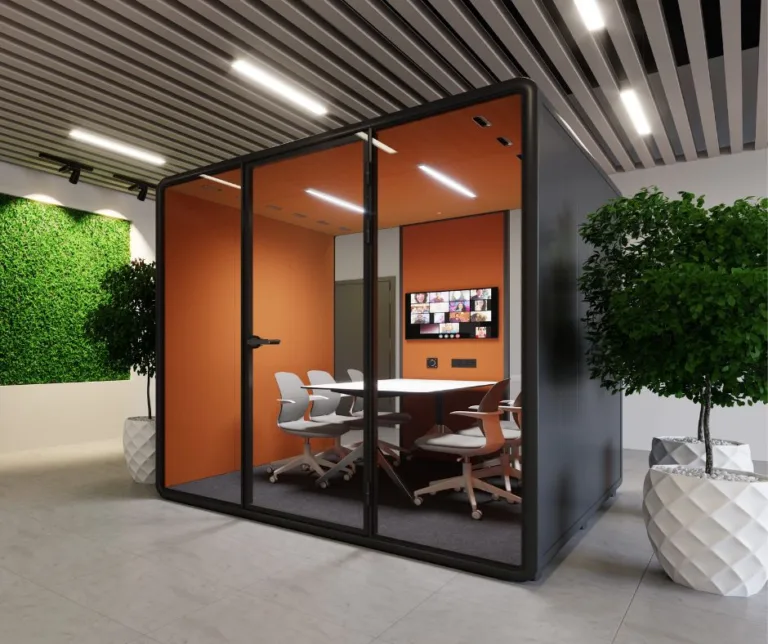
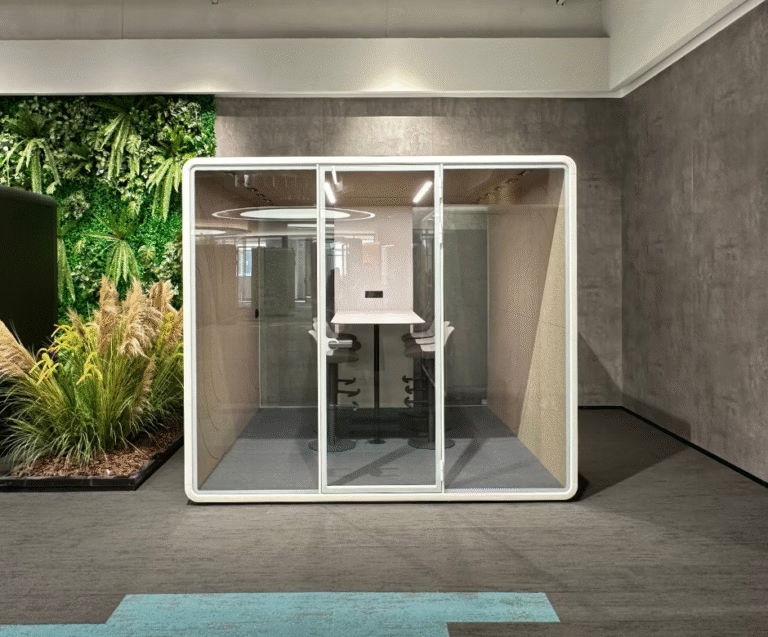
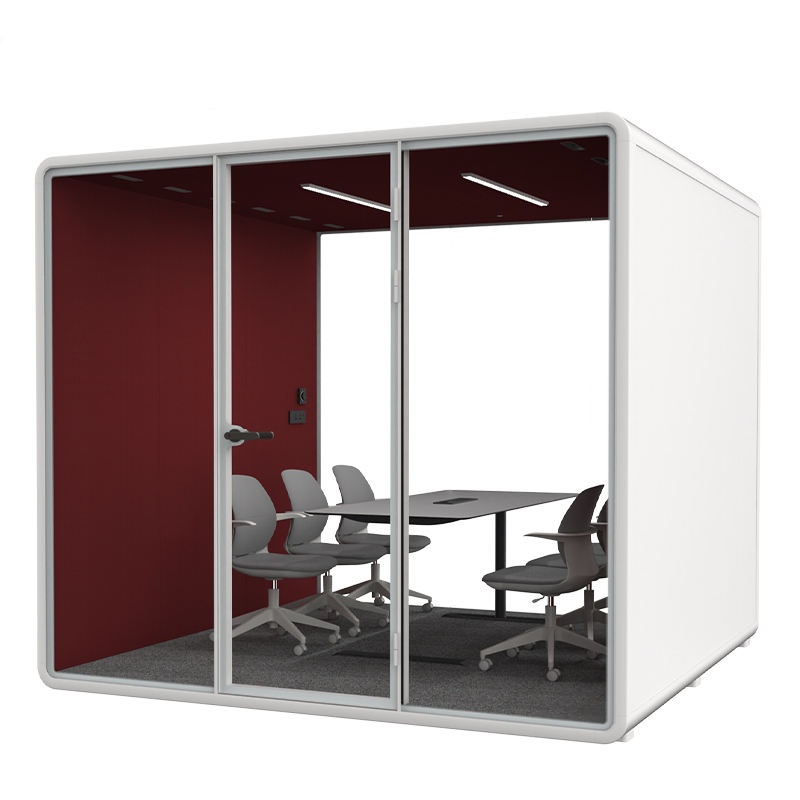
Specifications
| 6-Persons Meeting Booth | 4-Persons Meeting Booth (for comparison) | |
|---|---|---|
| Capacity | Up to 6 people | Up to 4 people |
| External W × D × H | 2600 × 2605 × 2326 mm (102.4 × 102.6 × 91.6 in) | 2300 × 1785 × 2326 mm (90.6 × 70.3 × 91.6 in) |
| Internal W × D × H | 2462 × 2565 × 2146 mm (96.9 × 101 × 84.5 in) | 2162 × 1745 × 2146 mm (85.1 × 68.7 × 84.5 in) |
| Floor area | ≈ 6.5 m² (70 sq ft) | ≈ 4.1 m² (44 sq ft) |
| Net weight | 784 kg (1,728 lb) | 606 kg (1,336 lb) |
| Acoustic performance | 30 ± 3 dB at 1,000–4,000 Hz | Same platform |
| Frame and glazing | Aluminium alloy frame, acoustic composite panels, 10 mm tempered glass | Same platform |
The parts that decide whether people use it
A meeting booth that is uncomfortable is a meeting booth that stays empty, and then somebody writes a review saying pods do not work. The things that matter most are unglamorous.
Ventilation is first. Ours runs below 35 dB, and if you are going to sit in one for two hours, you will notice the difference between 35 dB and 45 dB more than you will notice almost anything else on this page. Lighting is second: 3,000K to 6,000K, dimmable, because a one-to-one conversation and a video call want different light. Power is third, and it is the one people complain about, so there are multiple outlets plus USB-A and USB-C, because the meeting laptop is never the one with a charged battery.
Then the floor, which is anti-static carpet. Then the casters, concealed in the base, and the adjustable feet, which are how you level the booth so the door seals properly. That last point sounds trivial and is not. An unlevel booth has a door that does not close flush, and a door that does not close flush is where your acoustic rating goes to die.
Colours are standard or RAL-matched. Optional upgrades include enhanced acoustic glass, smart glass, single or double glazing, logo printing, and non-standard dimensions, which we can do because we build the frames ourselves in Foshan.
Deployment
The booth arrives assembled and works the same day. No structural modification, no permits, no permanent change to the building, which matters more than it sounds.
Offices put it where the demand is and move it when the team moves. Hotels get private call and meeting space without taking a room out of inventory. Hospitals and clinics get somewhere to have a conversation that must not happen in a corridor. Home offices get a corner that reads as a real meeting room on camera, which is a bigger deal than it used to be.
If you are at the fair
Six things worth doing at the booth, in this order.
Step inside and close the door. Have your colleague talk at normal volume two metres outside, then walk back into the hall and compare the two.
Listen to the fan. Stand in there with the ventilation running and decide whether you could sit in it for two hours.
Look at the door and the gasket. This is where cheap booths fail first, and you can usually see it in thirty seconds.
Sit six people in it. Not four. Use the configuration you actually need, with a table and a screen.
Ask about the air path. Ask us, and ask the next three booths along.
Bring your floor plan. A drawing with the booth marked on it is worth more than a brochure, and if a different model suits your space better, we will say so.
If you cannot make it to Guangzhou this time, the same conversation works by email. Send the headcount and the floor plan and we will come back with a recommendation.
The China Import and Export Fair runs October 15 to November 4, 2026 at the Canton Fair Complex in Guangzhou, in three phases.
Questions we get at every show
Does it block sound completely? No, and neither does anything else. Anyone who says their booth does is overselling. Ours cuts 30 ± 3 dB in the speech band, which in a normal office is enough that the conversation inside is not intelligible outside. That is the claim, and it is testable.
Can six adults really meet in 6.5 square metres? Yes, with a proper table. Internal dimensions are 2462 by 2565 mm, which is close to a small permanent meeting room. Sit in one at the fair and decide for yourself.
Do we need to modify the building? No. Standard power, level floor, done. Casters for moving it, adjustable feet for levelling it.
Can we put our logo on it? Yes, logo printing is a standard option, and we do RAL colour matching for corporate rollouts.
Can you build a non-standard size? Yes. Send the constraints and we will confirm feasibility and lead time.
Where is it made? Our own factory in Foshan, Guangdong. We design it, we build it, we export it.
Get in touch
Tell us the headcount, the floor plan, and the conversations you currently cannot host. We will point you at the right model, or build one to fit.
📧 Email: [fslaryu@gmail.com] | 📱 WhatsApp: [+8617324116489] | 🏭 Foshan, Guangdong, China