
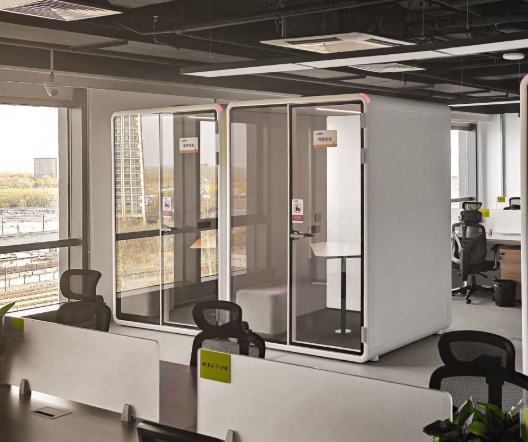
Open-plan offices solved a cost problem and created a noise problem. Office pods are the industry’s answer to the second one, and like most answers, they work well when they’re matched to the right job.
So it is worth being precise about what these things are, what each type is for, and what to check before you spend money on one.
The useful definition
An office pod, also called a privacy pod or an acoustic pod, is a small freestanding room. Frame, acoustic panels, glass, a door that actually closes, ventilation, lighting, power. It looks like a phone booth in photographs. Functionally it is something else: a room you can install in a place where you cannot build a room.
Keep that in mind and most buying decisions get simpler. If the space you need is not a room, and you cannot build one, you need a pod. If you can build a room, build the room.
Materials vary enormously by price point. The ones that last tend to use an aluminium or steel frame, composite acoustic panels rather than bare foam, and tempered glass rather than acrylic. Foam-only pods photograph well and stop performing within a year, because foam absorbs high frequencies and does very little to the low end of a human voice, which is the part that travels through walls.
Four types, sorted by the job they do
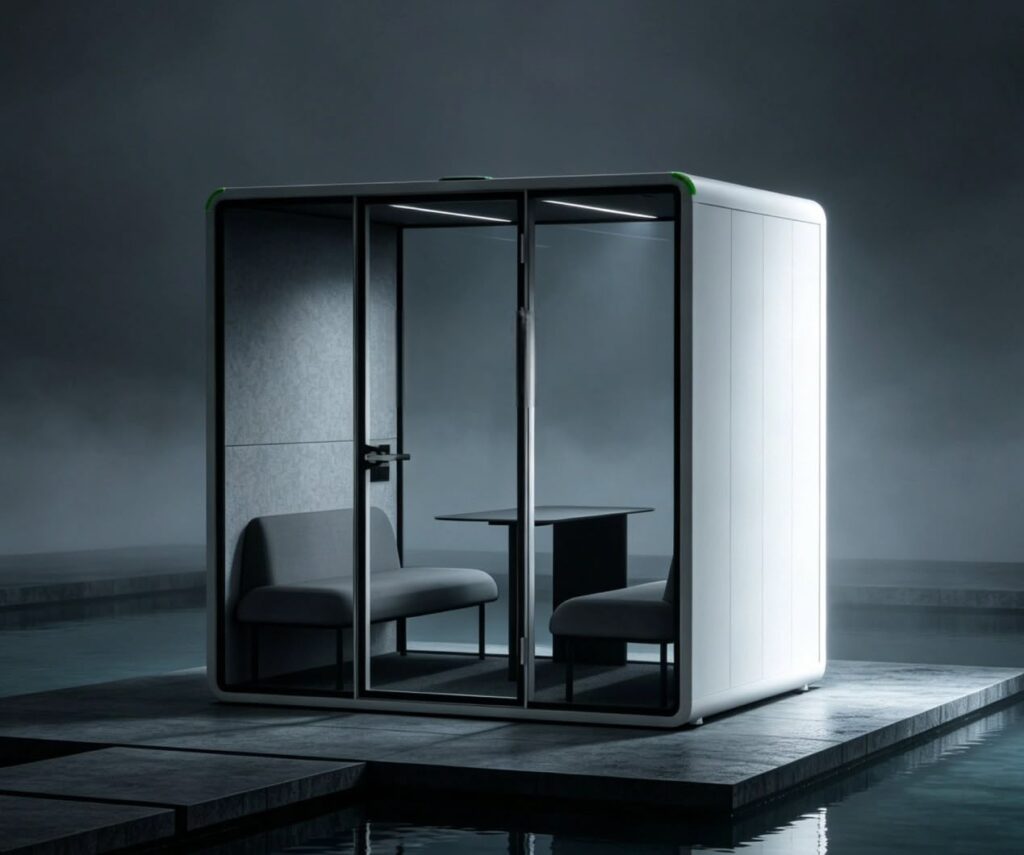
The industry sells pods by size. Buyers should think about them by job, because that is where the mismatches happen.
The phone booth. One person, roughly one square metre. Calls, video calls, and short bursts of focus. This is the volume seller, and in a lot of offices it is the only type anyone buys.
The focus pod. Also one person, but bigger, with room for a desk and a proper chair. Made for half a day of work rather than five-minute calls. Worth it if your problem is that people cannot get anything done in the afternoon, not that they cannot take a call.
The two-person pod. One-to-ones. Interviews. A performance conversation. Anything where two people need to talk and nobody else needs to hear it. These are under-bought, in our experience, and they are the ones that quietly stop the HR team from booking a room three floors up.
The meeting pod. Four to six people. A table, a screen, a door. This is the type that replaces a permanent meeting room, and it has grown fastest since hybrid work became normal, because a video call with four people in a booth works and a video call with four people at a desk does not.
The most common mistake we see is a company buying ten phone booths because the unit price is lower, then discovering that their four-person meetings still have nowhere to go. If you are planning a floor, mix the sizes.
What pods actually fix
Interruptions. A pod does not make anyone productive. It removes one specific obstacle, which is that an open office makes it very easy to interrupt someone. Recovering focus after an interruption takes time, and no reasonable estimate puts that time at zero. A door that closes is the cheapest version of that fix.
Confidentiality. This matters more than most buyers expect before they purchase. Every company has conversations that cannot happen on the floor: pricing, salaries, HR matters, interviews, legal questions, clinical discussions. When there is no private space, those conversations get postponed, or they happen in a stairwell at sixty percent candour, or they consume the only meeting room on the floor.
On the acoustic side, the number to look for is not a single figure. Ask what frequency band it applies to. Speech intelligibility lives between 1,000 and 4,000 Hz, and that is the band that decides whether your conversation is actually private. Our pods reduce noise by 30 ± 3 dB across that range, which in a normal office means the conversation inside arrives outside at a level below the ambient noise of the room.
Meeting capacity without construction. A four-person pod costs a fraction of building a meeting room, takes a day to install instead of months, needs no permits, and can move when your team moves. It also does not sit empty because it is on the wrong floor.
Flexibility. Pods relocate. That matters more than it sounds, because most office layouts get reorganised every few years. A pod survives that. A stud wall does not.
What we would check before buying from anyone, including us
The acoustic rating, and the band it applies to. One number with no frequency range is marketing. Ask for the range.
The door and the gasket. This is where inexpensive pods fail first. Open and close the door yourself, and look at the seal.
The ventilation. Two things matter here: how loud the fan is, and how the air path is acoustically treated. A booth can have excellent wall panels and still leak through its duct. Ask directly and see whether you get a straight answer. In our booths the fan runs below 35 dB.
Power. Multiple outlets, plus USB-A and USB-C. The laptop people bring to a meeting is never the one with a full battery.
Lighting. Dimmable, and adjustable in colour temperature. A one-to-one conversation and a video call want different light, and a pod with a single cold white panel feels like a server room.
How it gets into your building. This gets asked last and should be asked first. A six-person booth is a large object. Check lift dimensions, corridor turns, and door widths before you order, and confirm whether it arrives assembled or in panels.
Whether it can be levelled. Casters to move it, adjustable feet to level it. An unlevel pod has a door that does not close flush, and a door that does not close flush undoes the acoustic rating you paid for.
When a pod is the wrong answer
If you have a spare office, use the spare office. If your real problem is that a handful of people take loud calls at their desks all day, the fix might be a policy about where calls happen rather than a piece of furniture. And if you need a room for twelve people, buy a room.
Pods are good at one thing: creating a small, quiet, private space in a building where no such space exists. In an open-plan office with more people than quiet corners, that is usually enough to justify the cost.
Want a price, or help choosing?
Tell me which of the four jobs matters most — reading, focused work, recording, or online classes — and how many people need space. You’ll get a recommendation, pricing, and the acoustic test reports back. Usually the same day.
📧 Email: [fslaryu@gmail.com] | 📱 WhatsApp: [+8617324116489] | 🏭 Foshan, Guangdong, China