
Written by the people who weld the frames.
A guy from Manchester wrote to us last spring. Four lines, no greeting, and somewhere in the middle of it he mentioned that his upstairs neighbour had started thumping the floor at eleven every night.
So he’d cut his streams at 10pm. Which would be fine, except his audience is mostly American, and 10pm in Manchester is the middle of their afternoon. Nobody’s watching yet. Two years building that audience, and his schedule belonged to the man upstairs.
He asked two things. Would a booth fix it. And what does the cheapest one cost.
Yes, and I’ll get to the money later.
The part that stuck with me came after, almost as an afterthought. He isn’t a shouter. He plays games, talks to chat, laughs at his own bits. He said it like he was making an excuse. And he was right to, because a man laughing at his own joke at eleven at night goes straight through a floor and into somebody’s bedroom, and the person lying up there is in no mood to appreciate the difference between streaming and shouting.
What the noise complaint is really made of
Not music, usually.
Your voice, mainly. And not because you’re loud. Voice is just a bigger sound than people give it credit for, and streamers don’t talk, they perform. There’s the voice you put on, the laugh, the shout when a bit lands. A pop filter doesn’t change any of it. The mic only decides what your audience hears; your throat decides what your neighbours hear, and it’s coming out in every direction.
The hour is the other half. Half-past two in the afternoon, nobody complains about anything. Same conversation at midnight and you’re the reason someone’s awake. Nothing about the noise changed. Only the clock.
Speakers, third. Fixable in ten seconds with headphones, so if your complaints are specifically about thumping bass, put the music in your ears and see if that’s the end of it. I mean that. Come back if it isn’t.
Foam doesn’t do what the internet says it does
Every streamer goes through the same three stages, and we talk to people at the middle stage constantly — wall covered in foam, extra complaint anyway.
Headphones are stage one. They’re for sound coming in, not going out. They do nothing for your voice leaving the room.
Foam is stage two. Those panels exist to kill reflections inside a room, and they genuinely make your stream sound better. They are not a barrier. Egg-crate foam an inch thick can’t stop a voice, because stopping a voice needs weight and airtight edges. Soft surfaces absorb what bounces around inside the room. They don’t stand in the way of what’s trying to leave. Watch how much difference it makes and then decide.
Stage three is a sealed enclosure with mass in the walls and proper gaskets on the door. That’s the whole product, honestly. Everything we do here in Guangzhou comes down to that one sentence, and the rest is build quality.
What actually changes once it’s in place
You stream when your audience is awake. For anyone in Europe or Asia with a US audience, that’s the whole case. Your hours stop being someone else’s decision.
Your audio improves too, and for a reason most streamers don’t see coming. A booth removes the room from your recording. Bedrooms are genuinely awful places to talk into a microphone. Bare walls, a wardrobe, a window on one side, that hollow slap under every word. People spend weeks with plugins chasing this. The room is the problem. A booth is a room you can buy, and it’s cheaper than the time you’re currently spending on it.
The quiet one, third: you stop half-performing. Most streamers we speak to are holding back without realising it. One ear on the wall. Not laughing properly. Watching the clock. Take that away and you get your show back, which is a strange thing to say about a box, but it’s what people tell us.
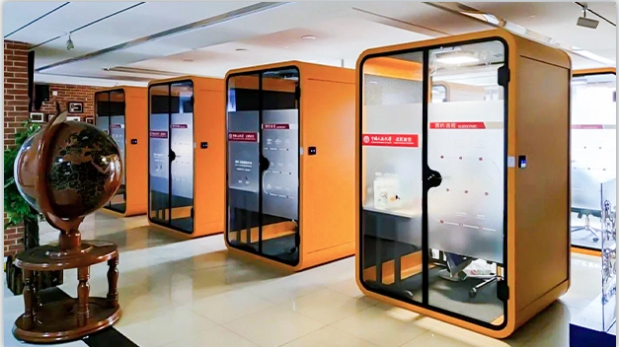
We spec these as the single voice recording model. Sealed seams, 50mm rock wool in the panels, double laminated glass, baffled vent. Around 30dB of reduction. What that means in an apartment: the neighbours hear nothing they can identify.
One limit, since someone asks every week. If you run a subwoofer, no booth we make will help you. Low bass travels through the building itself, not through the air, and nothing made of panels stops it. Headphones or nothing. I’d rather tell you now than after you’ve paid for shipping.
Six hours is a long time inside a box
Air first. This is the one everyone underestimates. Ours swaps the full volume of air every two or three minutes and you can’t hear the fan on a mic. Without it you’ll be propping the door open halfway through a stream, which is the whole point thrown away.
Light, if you’re on camera. Watch your colour temperature. We use 4000K neutral, flicker-free, because a warm LED strip plus a window plus a monitor gives you two different skin tones and no way to fix it in post.
Background. Decide before you order, because nobody wants to be swapping glass on an installed pod. Camera facing frosted glass? You get a soft neutral backdrop and your flat stays private. Clear glass? You get depth, and your audience gets to see whatever mess is behind you. That’s a choice, not a default.
Cables. Tell us what you’re plugging in. Interface, mic, monitor, stream deck, a USB hub, power for a phone. There are routing channels in the standard build. Drilling a finished pod is the expensive version of this conversation.
And a mat under it. Shifting in your chair sends vibration down through the floor to the person below, particularly on wood. Two centimetres of rubber costs less than a mic cable and does more than you’d guess.
Not only streamers
Same box, different people. Online tutors. Podcasts. Voiceover for ads. Someone practising violin, badly, at nine in the evening. A salesman whose kids are asleep two metres away. Two orders last month were for guided meditation recordings, which is not a noisy occupation, but the customer’s flatmate disagreed.
Specs
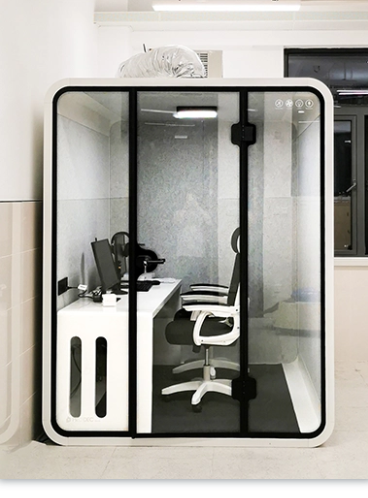
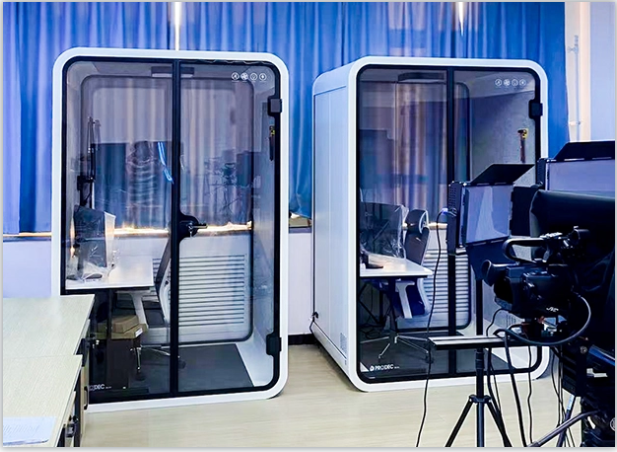
| Model | Single Voice Recording Booth (two-person version for co-streams) |
| Reduction | Up to ~30 dB, test reports on request |
| Build | 50mm rock wool panels, double laminated acoustic glass, compressed gaskets, baffled vent |
| Air | Full air change every 2–3 minutes, fan below mic level |
| Light | Flicker-free 4000K |
| Glass | Clear, frosted, or switchable |
| Power | Sockets, USB, cable routing; ETL/UL option for North America |
| Warranty | 3 years on structure and electrics |
Build time 15–25 days, then sea freight, usually 25–35 days more depending on the port. One unit is a normal order, not a favour. Two people assemble it in about two hours. There’s a video, and if the video isn’t enough, call us.
Then what happened
He assembled it on a Sunday. First stream back was Tuesday, eleven until three.
Nothing. No thumping.
The day after, the neighbour caught him in the hallway and asked whether he’d moved out.
I don’t think we’ve had a better review than that one.
Want a price?
Tell us what you do — streaming, lessons, podcast, voiceover — how long a session runs, and whether you need to be on camera. You’ll get a model recommendation, pricing, and the acoustic test reports.
📧 Email: [fslaryu@gmail.com] | 📱 WhatsApp: [+8617324116489] | 🏭 Foshan, Guangdong, China
🏭 Our own factory: Guangzhou, Guangdong, China