
Notes from a factory floor. Mostly about being overheard, not about noise.
Two years ago a guy from Texas called us. Purchasing manager, mid-forties, impatient. I started my usual pitch — acoustics, focus, productivity, the whole thing. He let me get about ninety seconds in and then stopped me.
“I don’t care about the noise,” he said. “Last month I closed a contract on my phone at my desk. Twenty minutes later a guy from another department asks me why we’re paying that rate. He’d heard every number.”
That’s it. That’s the whole reason most of our booths get bought, and I’d been selling the wrong thing for years.
So this article is about privacy. Where it leaks, what actually stops it, and which booth does what.
Quiet and private aren’t the same thing
People treat these as synonyms. They’re not, and the gap between them is where money gets wasted.
Quiet means you aren’t disturbed. Private means you aren’t overheard. A booth can do the first beautifully and fail the second completely, and you won’t find out until something you said privately comes back to you from the wrong person.
Where it leaks. Four places, in order of how often they cause problems.
The door. Everyone asks about panel thickness. Almost nobody asks about the gap around the door, which is where most of the sound actually leaves. A door without compressed gaskets is a nearly open window. I’ve stood in front of booths at trade shows where you could slide a business card through the gap on the hinge side, and the sales guy is telling me about their 35dB rating. Ratings on paper are worth what you pay for them.
Second, the vent. Air has to move. Sound moves with it. If the duct is just a hole in the ceiling panel, your conversation goes into the ceiling void and comes out over the whole floor. We once had a customer send back a competitor’s booth for us to look at, nice walls, honestly good panels, and an unlined vent pipe you could have shouted through.
Third, speech versus noise. This one trips up buyers constantly. A booth can be good at blocking low rumble — traffic, air conditioning, machinery — and still let a human voice through, because they behave differently. The number that matters for privacy is speech intelligibility. Can the person at the next desk pick out your words? That needs dense material and sealed joints, not just mass.
Fourth, the floor. Structure carries sound. On bare concrete or hard vinyl with an open plan, vibration from footsteps and drawers travels up through the booth. A rubber mat under it fixes most of this. Cheap fix, easy to forget.
What people actually need to keep in there
Contracts mostly. Pricing, terms, supplier negotiations — the Texas situation. Anyone whose job involves numbers other people shouldn’t know.
Client calls, the ones where the client is showing you their dashboard, or walking you through a defect, or telling you something they expect to stay between your two companies.
HR. Reviews, salary, someone coming back from medical leave and not wanting the floor to know why. I’d guess a third of our single-booth orders are for exactly this, and the buyer often doesn’t say it out loud. They just ask about a lock.
Interviews. Nobody gives you a straight answer to “why are you leaving your current role” if six people can hear it.
Legal and money. Lawyers, accountants, board calls, anything before it’s public.
And a category people don’t mention in the meeting but do mention to us privately: employees taking calls about their own health, their parents, their debts. That shouldn’t require asking permission.
The five models, and which one solves which problem
Buying by size alone is a common mistake. The right question isn’t how many people fit — it’s what kind of conversation needs to stay inside.
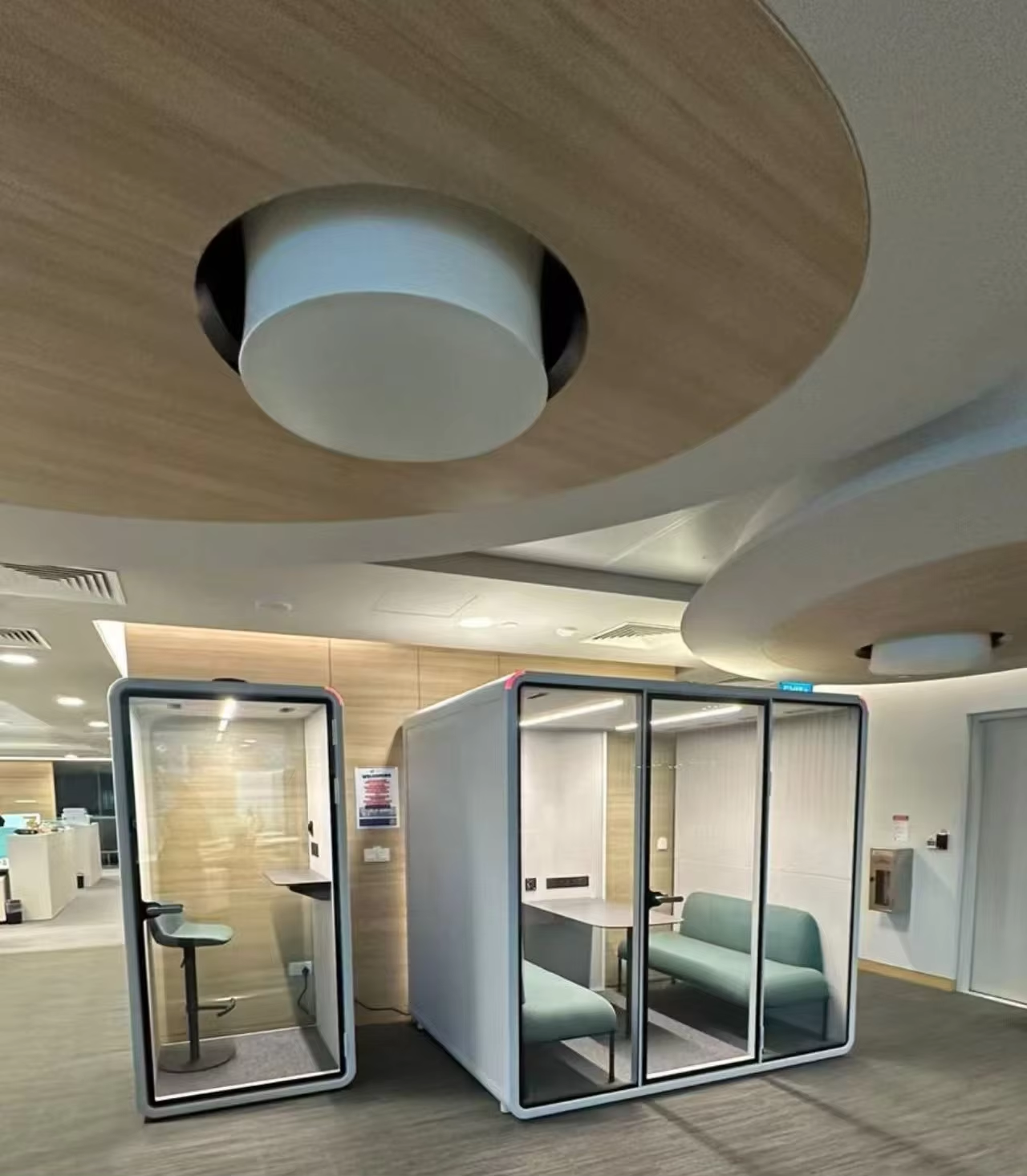
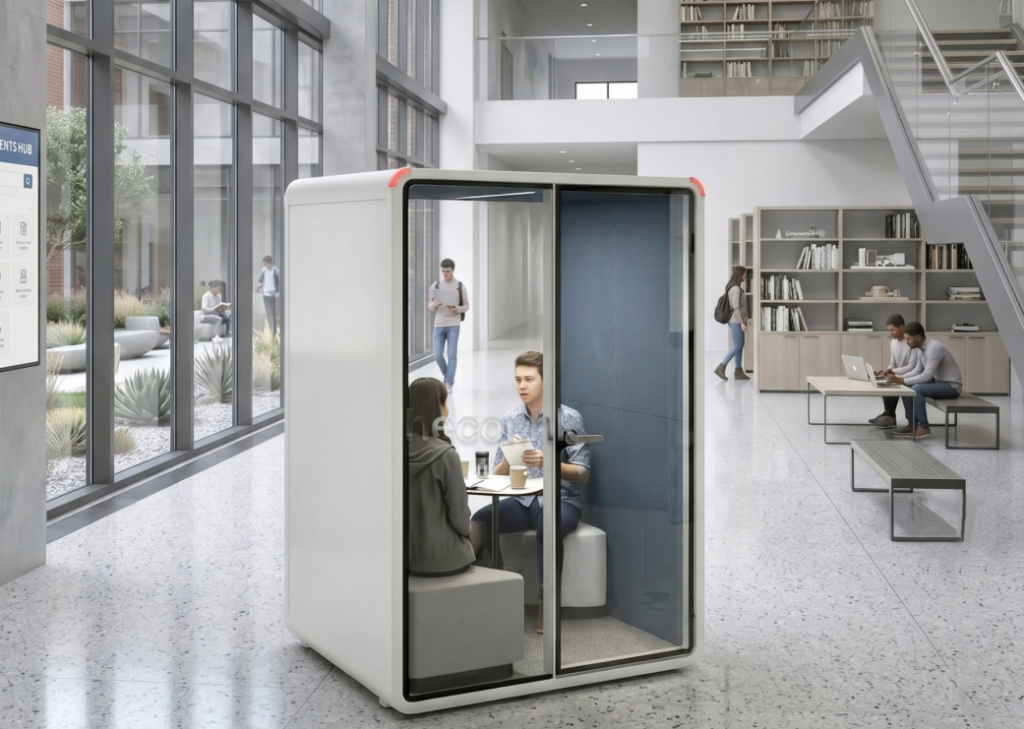
If you’re on client calls all day, or you’re the one signing contracts, you want the Focus Office Pod. Single person, sealed, set up for video. This is the one most companies order first and the one we build the most of. Get the gaskets and the baffled vent right and the neighbouring desk registers only that you’re talking.
The 1 Person Soundproof Booth does the same job but usually ends up in HR, or in the office of whoever conducts interviews. Same shell, different interior. Order frosted glass on this one. Acoustic privacy keeps the words in, but clear glass in a booth tells the entire floor that somebody is being spoken to seriously, and that alone starts rumours.
For recording, it’s the Single Voice Recording Booth. Two very different customers buy this. Podcasters and video people who don’t want half-finished work floating around a shared studio, and companies recording training material, call recordings, or voice data for AI training. That second group cares about leaks in a way that isn’t about embarrassment — there are contracts and compliance rules attached. We build these tighter than standard, sealed seams, no unlined paths, and the interior configured for voice rather than for stuffing things in.
The Online Class Study Pod is the one people buy for their home. A tutor working from a one-bedroom flat, a student in a shared house taking a lecture at 2 a.m. because of the time difference, a kid whose parent is on a work call in the next room. Nobody in that situation wants the household broadcast to a stranger on video, or the lesson broadcast to the neighbours. Light interior, no flicker in the lighting, because a face in shadow on a webcam reads as somebody who doesn’t care.
Last one, the Quiet Reading Pod, and honestly this is the model buyers understand fastest once we explain it. Contracts before signature, case files, board papers, personnel records. A laptop screen facing an open office isn’t a document, it’s a display. Libraries and law firms both buy these for the same reason. Just don’t skip the ventilation on this one — three hours of reading in a sealed box with no air is miserable, and we’ve had that complaint exactly once, from an early model, and it taught us something.
What we build, and three questions to ask anyone
Our panels are filled with 50mm rock wool. Not foam, not honeycomb cardboard with a nice photo on the website. Glass is double laminated acoustic glass. Door and seams use compressed gaskets. The vent has a baffle so there’s no straight path from inside to outside. Roughly 30dB of reduction, and more relevant here, speech from inside isn’t understandable from a normal desk away.
I’m not claiming we’re the quietest in the world. Test us instead of believing me. Three questions worth asking any supplier, us included.
Is the vent baffled? Are the door gaskets compressed, or stuck on with adhesive? Can you show me a report about speech, not just a single overall noise figure?
If a seller dodges the second question, that tells you what you need to know.
Specifications
| Model | Built for |
|---|---|
| 1 Person Soundproof Booth | HR, interviews, sensitive one-to-one calls |
| Focus Office Pod | Contract negotiation, client video calls |
| Single Voice Recording Booth | Podcasts, voiceover, training and AI voice data |
| Online Class Study Pod | Remote lessons, tutoring, study at home |
| Quiet Reading Pod | Confidential documents, silent study, focus |
Common to all: 50mm rock wool panels, double laminated acoustic glass, compressed seals, baffled ventilation, fresh air exchange every 2–3 minutes, flicker-free 4000K lighting, sockets and USB, cable routing. Frosted or switchable glass optional. ETL/UL electrical option for North America. Three years on structure and electrics. Two-person assembly, about two hours. Production 15–25 days plus sea freight, usually another 25–35 days depending on the port. Single units welcome.
One thing on ordering. Start with one booth, the model that matches your most sensitive conversations, and put it where people actually work. Then watch who fights over it. That tells you more about your real requirement than any planning meeting will.
Want a price, or help choosing?
Tell me which of the four jobs matters most — reading, focused work, recording, or online classes — and how many people need space. You’ll get a recommendation, pricing, and the acoustic test reports back. Usually the same day.
📧 Email: [fslaryu@gmail.com] | 📱 WhatsApp: [+8617324116489] | 🏭 Foshan, Guangdong, China